Showing posts with label myrrh. Show all posts

Friday, August 5, 2011

By Kilian - Sweet Redemption, The End

Alpha and Omega

Sweet Redemption, The End is the 10th and last perfume in By Kilian's L'Oeuvre Noire series, that has explored themes of love and temptation. I previously reviewed Love and Tears, Surrender which is one of the best jasmines I've ever tried.

In this final perfume, Kilian has created a complex balance of opposites. Sweet and bitter, light and dark, innocence and death, or is it rebirth? 

Sweet Redemption, The End starts with creamy orange blossom, a flower often associated with innocence. The pale creaminess melts into a heart of darker, sticky resins. The sweet smell of vanilla and cinnamon comes from benzoin but the perfume stays away from gourmand territory by the addition of bitter, medicinal myrrh.

Myrrh is an incense often associated with death and funeral preparations. It has a fragrance that takes time to love. I find that myrrh adds an almost plastic note to Sweet Redemption, as if the perfume is actually a sweet but synthetic amber, melting on my skin. Like vanilla ice-cream and dark honey frozen into bakelite.

At one point the light layer of orange blossom hovering over the incense base notes, created an illusion of lilies, Like a stereogram image created from two separate photos. Lily isn't mentioned in the notes, and maybe it was all in my head, but it fits with the theme of endings and redemption, death and rebirth. Lilies are the flowers of both funerals and Easter.

So in one fragrance, By Kilian leads us on an olfactory journey from beginning to end. Innocent fresh orange blossoms mixed with evocative ancient resinsto offer redemption as the ultimate temptation.

Sometimes I find the By Kilian ad copy a little florid, their packaging a little pretentious and their prices steep, but I have to admit the juice is outstanding quality. By Kilian will be offering the L'Oeuvre Noire series as a complete set of travel-sized atomizers this fall and I am tempted.


House: By Kilian
Nose: Kilian Hennessy
Notes: Orange blossom, bitter orange leaf1 vanilla, myrrh, opopanax, benzoin2, incense

1 Bitter orange leaf is mentioned only on the By Kilian website.
2 Benzoin is mentioned only on the Luckyscent website.

Tuesday, January 11, 2011

Serge Lutens - Ambre Sultan

How a perfume changed my life

In 2008, I became a perfumista. I had worn perfume since I was a girl, but I wore it in the way my mother did, one bottle at a time; usually the same scent for five years or more. In the fall of 2008, I started to grow restless again with my signature scent and began to look for a new one. While doing some research, I discovered perfume blogs and niche fragrances. The name Serge Lutens was used often, and reverentially on these blogs, so I sought out the line, which at the time was carried by The Bay. Just one small spritz of Ambre Sultan changed everything.

I remember thinking "Oh, this is so spicy, and too masculine for me" but all the way home I kept sneaking whiffs of my wrist. Ambre Sultan was so interesting; it was layered and complicated. It smelled like a mysterious and exotic landscape. It was sweet but had something herbal or medicinal in it too. And later, I thought "Whoa, this stuff smells like pure sex." It was addictive.

Ambre Sultan opened a whole new world of scent for me. For the first time I started to appreciate perfume, not just as something pretty to attract the opposite sex, but as a personal pleasure. And I was free of the idea that I had to choose one "signature" fragrance - I could have more, one for every mood, as many as I wanted. Perfume was more than an accessory; it was an accessible art form. It inspired and entertained me. It created visions in my mind of places, people, moods and emotions.

Through perfume, I rediscovered my love of art history. Like paintings, perfumes could be abstract or realistic representations. There were styles, modern and classic schools, new stars and old masters, commercial mass products and exclusive hard to find items. Unlike painting, the price range for most of these fragrant art pieces was exactly what I could afford.  Although I know it's a stretch to call perfume practical, something in my basic nature liked that the art I was buying was usable. I would rather buy something that will walk around with me all day, than something that will hang on a wall.

It was all over for me from there. Soon, I bought a full bottle of Ambre Sultan, then more bottles, from Frederic Malle, Ormonde Jayne, L'Artisan Parfumeur, Eau d'Italie and more. I went through phases, first addicted to heavy ambers and spices, then woods, incenses, then later discovering I could love flowers too, like roses, gardenias, jasmine, and orange blossoms. Chypres rocked my world. I disdained vintage, I loved vintage. I continue to change and grow in my perfume choices, and I hope I always do.

Enough about you, what does it smell like?


To those of you who scanned everything above to get to this part, Hello! (I do that too.)

Ambre Sultan is linear but multi-layered. It has a sweet, heavy, amber base, like thick, dark vanilla-scented syrup. Floating over this resiny amber is an aromatic smoke of warm spice. There's a medicinal note, which comes from the angelica root, also used in herbal cough remedies like Ricola pastilles. A warm woodiness lies underneath, and a personal smell, like a lover, that may be the myrhh*.

Ambre Sultan is a must try for all perfume lovers. And if you do try it, let me know if it blew your mind.


House: Serge Lutens
Nose: Christopher Sheldrake
Notes: coriander, sandalwood, bay leaf, patchouli, angelica, resins and myrrh

Photo: Amber Fort, Jaipur, Wikimedia

* A recent post by Katie Puckrik called myrrh "scalpy." Maybe that contributes to the afterglow, cuddling in bed, feeling I get from Ambre Sultan. What do you think?

Friday, December 24, 2010

We Three Kings: Eau d'Italie - Paestum Rose

A rose among the ruins
Myrrh is mine: Its bitter perfume
Breaths a life of gathering gloom.
Sorrowing, sighing, bleeding dying,
Sealed in the stone-cold tomb.
This is my final post in the We Three Kings series. Many thanks, first to Joanne at Redolent of Spices for starting this project with me and also to all the other amazing bloggers who joined us. Their posts have all been awesome and I'm so happy to have made so many new perfume-fanatic friends. Check them all out from the links at the bottom of this post.

Myrrh

After gold and frankincense, the Magi gave myrrh to the baby Jesus. Like frankincense, myrrh is another resinous incense, collected as tears from the damaged bark of trees.

Myrrh was the gift that symbolized death.  Way to ruin the festive mood there, Magi. Myrrh was an essential ingredient in ancient Egyptian funeral rites and was also commonly used in ancient times as a medicine to treat wounds and pain. Jesus was offered a cup of wine with myrrh in it before he was nailed to the cross. The taste of this medicine was apparently not so good - the word myrrh derives from the Aramaic word for "bitter."

What does it smell like?

Myrrh is a difficult note for me, I find it sometimes hard to isolate in perfumes, but, despite the origins of its name, I don't think it's a bitter smell. Myrrh to me is lightly sweet and woody, as you would expect a tree sap to be, It's not the intense, nose-tickling warmth of frankincense. Instead I think of myrrh as being a "cool" incense, if that makes any sense. Like smooth grey stones.

Myrrh works well in Paestum Rose, which is a perfume created to reflect the beauty of Paestum, Italy, a city famous for its ancient Greek temple ruins and its roses. Myrrh combines with a sheer rose to create a perfume that's light and cool on floral on top but also resinous and woody and comforting underneath. The rose is pale pink in my mind, and with a lightness like peony. A pink pepper spices it up and bridges the gap between the rose and the wood. The far drydown has something more piquant, maybe some black-currant, making it end sweeter than it began.

Paestum Rose is the smell of melancholy but also happy memories. Maybe I'll save Paestum Rose for the day after Christmas, a day for cleaning up wrapping paper and relaxing with a new book.

Merry Christmas everyone, and a fragrant New Year!

House: Eau d'Italie
Nose: Bertrand Duchaufour
Notes: davana, pink and black pepper, coriander, osmanthus,Turkish, incense, myrrh, opopanax, papyrus, Wenge wood

Please visit all these other blogs during We Three Kings week:

Three Kings Icon ©2010 Megan Ruisch 

Tuesday, December 21, 2010

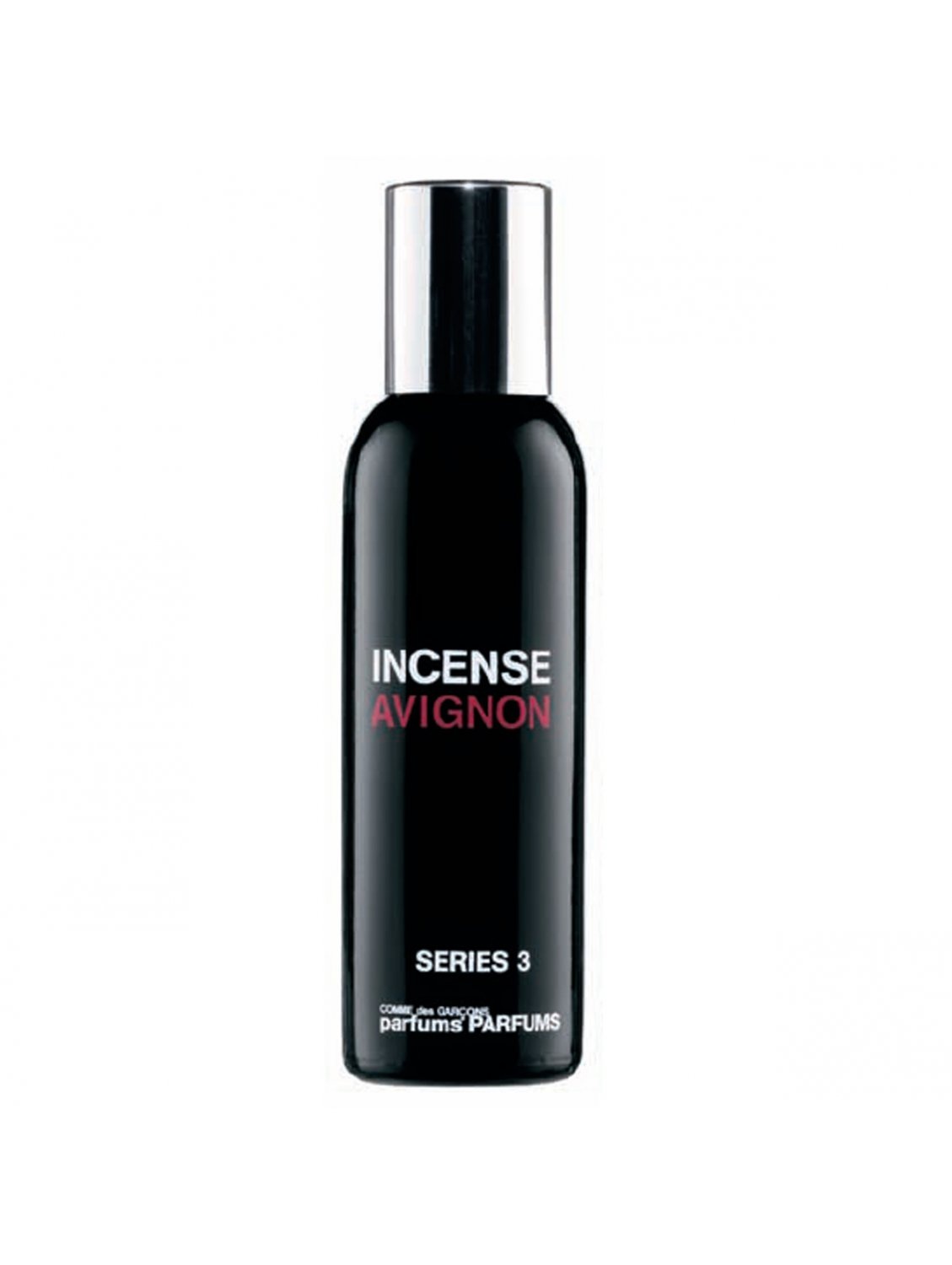
We Three Kings: Comme des Garçons Incense Series - Avignon

Does heaven smell of frankincense?
Frankincense to offer have I.
Incense owns a Deity nigh.
Prayer and praising all men raising,
Worship Him, God on high.
Welcome to my second post of We Three Kings week. The first perfume I reviewed was for gold, and this post is dedicated to the second gift of the Magi: frankincense. Frankincense is the gift that represents prayer.

Incense

Incense has been associated with communication with the divine since ancient times. It's mentioned in Indian Vedic scriptures from 5,000 B.C., and in ancient Egyptian tablets. Burning incense was serious business to the Jews during the time of Christ's birth; "holy" incense was burned only on special alters, by priests. It seems we humans have always found the fragrance of burning incense special and uplifting.

The Comme des Garçons Series 3 Incense is devoted to the five main spiritual teachings of the humanity; each one associated with a particular type of incense. Avignon represents Christianity and is focused on frankincense.

Frankincense did not start to be used in Catholic churches until the 4th century. Also called Olibanum, frankincense was introduced to Europe by Frankish raiders, hence the name. It's an aromatic resin harvested from trees native to the Arabian peninsula and north Africa. When the bark of tone of these trees is damaged, sap extrudes that hardens into lumps called "tears." The best frankincense comes from trees that grow in the harshest of locations, sometimes attaching themselves to barren rock.

What does Avignon smell like?

It smells like a Gothic cathedral. I've never been to a catholic mass where they swing the censors of incense, sending fragrant smoke over the congregation, but I've read from other reviewers that Avignon is pretty close to the actual experience. The frankincense is desert dry and woody in a way that brings polished wooden pews to mind.

Avignon is dark and contemplative; it smells of huge open spaces and dim lights. It's sheer, as if looking through smoke, but long-lasting and has significant sillage. In the drydown, an herbal chamomile and a gentle hint of vanilla soften the austere Gothic outlines of the perfume.

I find Avignon very meditative and comforting to wear. It clings to the fur collar of my coat, and when I smell it I imagine flickering candles in stone cathedrals and the sound of prayer. This is my scent for Christmas eve.

House: Comme des Garçons
Nose: Mark Buxton
Notes: Chamomile, Cistus, elemi, Myrrhe, Incense, Patchouli, Vanilla, patchouli, palisander, ambrette seeds


Please visit all these other blogs during We Three Kings week:

Photo: Notre-Dame des Doms d'Avignon
Three Kings Icon ©2010 Megan Ruisch

Thursday, September 23, 2010

DSH Perfumes: Secrets of Egypt, Part 2 of 3: Cardamom and Kyphi and Antiu

Smell like an Egyptian

Perfumer and aromatherapist Dawn Spencer Hurwitz collaborated with the Denver Art Museum on a set of special perfumes to accompany their 2010-2011 King Tut exhibit, The Secrets of Egypt. The perfumes are only available from the DAM and the DHS web site.

This is the second part of my 3 part review on the Secrets of Egypt collection. See part 1 here.


Cardamom and Khyphi
" probably the most famous of all early Egyptian perfumes handed down to us from antiquity"


The famous Egyptian perfume Kyphi was primarily used as an incense in temples and also as a remedy for ailments like nightmares and snake bites. The Greek physician Dioscorides wrote down one of the earliest surviving recipes for Kyphi. Piny and Plutarch also mentioned it and its various ingredients, which included: wine, honey, raisins, cinnamon and cassia bark, cedar, juniper berry, and resins such as frankincense, myrrh, benzoin, and labdanum.

Cardamom, although not native to Egypt was imported from India in ancient times. It works beautifully with the cinnamon. CaK is mostly cardamom and cinnamon to my nose, with a dry woody base. It's delicious. If you like those spices, I would definitely give it a sniff.

Notes:
Top notes: Cardamom co2 Absolute, Cardamom Seed
Middle notes: Khyphi
Base notes: Khyphi

Antiu (aka Metopian)
Antiu is the name we chose for our modern adaptation of “Metopion”, a famous Egyptian perfume that had been known some 300 years before Pliny the Elder and Dioscorides mentioned it. ... it was widely considered to be “the most exquisite fragrance imaginable, hence the ideal scent”.
Antiu starts with a strong lemongrass note but dries down to something faintly grassy, sweet and balsamic. It's very herbal and the most "natural" smelling of the group.

Notes:
Top notes: Bitter Almond, Cardamom co2 Absolute, Fragrant Wine (accord), Galbanum, Lemongrass
Middle notes: Australian Sandalwood, Gallica Rose Otto, Honey Beeswax
Base notes: Copaiba Balsam, Mastic, Myrrh Gum, Peru Balsam, Pine Resin, Sweet Flag

House: DSH Perfumes, Parfums des Beaux Arts CollectionNose: Dawn Spencer Hurwitz


Tuesday, September 21, 2010

DSH Perfumes: The Secrets of Egypt Collection, Part 1 of 3: Arome d'Egypte and Keni

Walk like an Egyptian

Perfumer and aromatherapist Dawn Spencer Hurwitz collaborated with the Denver Art Museum on a set of special perfumes to accompany their 2010-2011 King Tut exhibit, The Secrets of Egypt. The perfumes are only available from the DAM and the DHS web site.

This is part one of my 3 part review of the Secrets of Egypt Collection. 

From a limited palette of notes, those that would have been used in ancient Egyptian perfumes, DSH has created a amazing collection of beautiful and wearable fragrances. By using many of the same notes in each, the collection stands together, but each perfumes focuses on a different accord and has its own personality.


Arome d'Egypte (Special Edition)

Inspired by the perfumes of the Pharaohs. 
Arome d'Egypte focuses on the scent of spikenard. Oil from the root of spikenard was prized in the ancient world as a perfume fit for kings. Kept in alabaster vessels, spikenard was a luxury that had to be imported from far away Nepal. Spikenard is mentioned 3 times in the bible's Song of Songs and the New Testament tell us that Mary of Bethany used a whole pound of costly spikenard ointment to annoint Jesus's feet, causing some grumbling about the waste of money amongst the disciples. I've never smelled it, but reportedly spikenard has a sweet/spicy/musky scent and that's what I smell at the heart of Arome d'Egypt.

Arome d'Egypte also uses many other aromatic ingredients from ancient perfumerie, and these notes are equally present. At first I smell frankincense and balsam then later cedar and cinnamon surrounding the herbal spikenard note. It's a very soothing herbal and resin fragrance with a hint of spiciness. Arome d'Egypte is one of two in the collection that I would consider buying myself.

Notes:
Top notes: Cassia
Middle notes: Centifolia Rose Absolute, Egyptian Jasmine Absolute, Spikenard
Base notes: Ambrette Seed, Atlas Cedarwood, Australian Sandalwood, Benzoin, Labdanum No. 3, Myrrh Gum, Olibanum (Frankincense), Peru Balsam


Keni (aka the Medesian / the Egyptian)
Keni (which means embrace) is the name we chose for our modern adaptation of “the Medesian”. ...Especially popular during Ptolomeic period, it is said that Cleopatra scented her feet with the Mendesian
Keni has a strong cinnamon note that is the star of the show, supported by cardamom. It dries down to base of myrrh with a hint of cinnamon. I think it would be nice to have my feet smell like Keni, but it's not a perfume I would wear often.

Notes:
Top notes: Bitter Almond, Cardamom co2 Absolute, Cassia, Cinnamon Bark
Middle notes: Australian Sandalwood, Benzoin, Fragrant Wine (accord)
Base notes: Atlas Cedarwood, Myrrh Gum, Pine Resin

House: DSH Perfumes, Parfums des Beaux Arts Collection
Nose: Dawn Spencer Hurwitz